
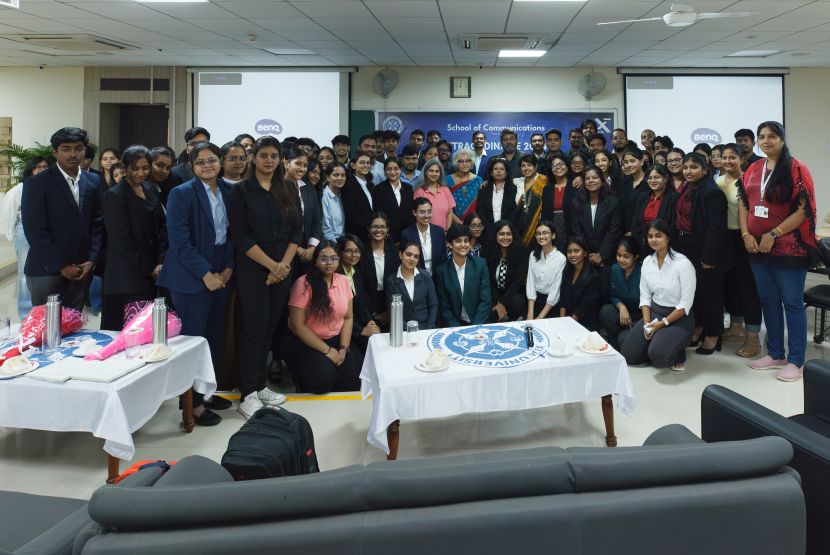
XTRAORDINAIRE 2024 a Media and Communication Symposium on the Theme: Framing the Future: Examining the ‘Mobile’ Consumers was held in Seminar Hall – II, Old Academic Block, New Campus, XIM University from 10:15 AM to 04:30 PM. Faculty Coordinator: Prof. Arpita Saha, School of Communications.
Objective: To help the students to gain practical knowledge about different domains of Mass Communication and learn how changing dimensions are affecting the markets.
To help the students to gain practical knowledge about different domains of Mass Communication and learn how changing dimensions are affecting the markets, Details:
School of Communications, XIM University, hosteded its flagship event, XTRAORDINAIRE 2024 an annual symposium focused on media and communications on 2nd August 2024, in association with XYNERGY – the functional committee of the School of Communications. Ms. Ishika Agarwal, Coordinator of the Students Activities Committee at the School of Communications, extended a warm welcome to everyone. Ms. Aditi Chaurasia, the PG Branch Secretary, provided an overview of the entire symposium. Ms. Nisha Patel, coordinator of XYNERGY Committee, defined the symposium’s theme.
The event commenced with a vibrant atmosphere, beginning with the ceremonial lighting of the lamp. This tradition was performed by Fr. S. Antony Raj, S.J. (Registrar, XIM University), Dr. V. Vijay Kumar (Dean of School of Communications), alongside four distinguished guests. The Esteemed Speakers: Ms. Paayel Sengupta (Associate Vice-President MSL Group), Ms. Abira Dhar (Entertainment Editor NDTV), Ms. Subha Das Mollick (Independent Filmmaker) Ms. Pooja Ambulkar (Creative Director Ogilvy). The symposium’s theme was “Framing the Future: Examining the ‘Mobile’ Consumers.”
Fr. S. Antony Raj, S.J., Registrar, XIM University addressed the gathering. He talked on the topic, illustrating the practices of ancient civilizations and tracing the evolution of the first mobile phone. He also highlighted the introduction of India’s first touchscreen phone and explored how modern media is radically exposed to everything.
Session I by Ms. Paayel Sengupta (Guest)
The first session of Xtraordinaire’24 was delivered by Ms. Paayel Sengupta who currently serves as the Associate Vice-President at the renowned MSL group India. In her role, she oversees numerous high-profile accounts and strategic initiatives. Previously, Ms. Sengupta held the position of Account Director at MSL, Bangalore, for four years. Ms. Sengupta participated in an internal mobility program at MSL Group, Japan, gaining invaluable experience in the health sector. This international exposure significantly enhanced her expertise. Some of the major national brands handled by her include Bharat AXA General Insurance, Himalaya Healthcare, Coca-Cola India, Uber and Ola.
She started her session by addressing today’s mobile consumers, primarily emphasizing on information and entertainment needs. Ms. Sengupta highlighted that mobile consumers access news in both informational or entertainment forms. She discussed how mobile technology transformed news consumption habits, noting that people are increasingly moving away from traditional newspapers. The era of solely relying on a journalist is fading, now, the reliability is moving increasingly on content producers. Journalism is no longer restricted to professional journalists as anyone can be a content producer. Citizen Journalism is encouraged among individuals so that anyone can create “snackable” content for the media. News can be consumed through various digital channels including e-papers, digital videos, images, infographics and other social media handles. Ms. Sengupta also presented a video of circulating rural news through mobile channels, showcasing the growing influence of mobile consumers in these areas. The moderator for this session was Ms. Aditi Chaurasia, the PG Branch Secretary final year students of MA Mass Communication.
KEY TAKEAWAYS:
• Mobile consumers now access news primarily in informational or entertainment formats, moving away from traditional newspapers.
• The role of journalism is evolving with the rise of content producers, allowing anyone to create and share news.
• Citizen journalism is encouraged, enabling individuals to create “snackable” content for media consumption.
• News can be consumed through diverse digital channels, including e-papers, digital videos, images, infographics, and social media.
• Mobile technology’s impact on rural areas is growing, with mobile channels increasingly used to circulate news.
Session II – by Ms. Abira Dhar (Guest)
In a dynamic and evolving media landscape, Ms. Abira Dhar, the Entertainment Editor at NDTV, believes that resilience and adaptability are essential. During her session at Xtraordinaire ’24 at XIM University, she shared her journey from being a small-town girl in Jamshedpur to a prominent journalist thriving in Mumbai.
Ms. Dhar emphasized the importance of persistence and stress management, highlighting that working in a news channel requires one to manage pressure effectively and maintain confidence despite challenges. She shared personal anecdotes, including her early aspiration to become a crime journalist, which she nurtured by documenting her thoughts and interactions in a small diary during her school days.
Her professional journey included her internship at Times Now, where she learned the rigors of entertainment journalism. Ms. Dhar advised aspiring journalists to understand the significance of standing by their sources and cross-checking information, stating that failure is a necessary part of growth and it’s okay to make mistakes.
Ms. Dhar also stressed the importance of being camera-friendly, interacting with the audience, and thinking visually, as journalism is a visual medium. She encouraged students to learn editing skills, including creating reels, and to be familiar with copyright laws. Ms. Dhar shared insights on the challenges faced by journalists, such as dealing with pressure and potential bullying in the newsroom. She underscored the necessity of standing up for oneself and being kind to oneself and others. Additionally, she touched upon the evolving nature of journalism, where being an influencer and adept with social media, is increasingly important. Overall, Ms. Dhar’s session was a blend of motivation and practical advice, offering students a glimpse into the realities of the journalism industry and how the sphere is changing with the growth of digital media. The moderator for this session was Mr. Mrinal Rout and Ms. Rituparna final year students of B.Sc. Mass Communication.
KEY TAKEAWAYS:
• Resilience and adaptability are essential traits in the ever-changing media landscape.
• Learning to manage stress and handle pressure effectively is crucial in a newsroom environment.
• Persistence is key; stick to your goals and keep pushing forward, even in challenging times.
• Always stand by your sources and ensure all information is cross-checked and accurate before reporting.
• Embrace mistakes as a necessary part of growth and understand that it’s okay to make them.
• Developing camera-friendly skills and effectively interacting with the audience is important, as journalism is a visual medium.
• Knowing how to edit reels and being familiar with copyright laws is essential.
Session III- by Ms. Subha Das Mollick – (Guest)
Ms. Subha Das Mollick is an experienced, independent filmmaker, who has been critically acclaimed for her compelling and engaging documentary films. She has been experimenting with the PEDAGOGY of the moving image and developing learning designs using film clippings. Her session was an enlightening lecture on documentaries and how they are perceived by the Indian masses.
Ms. Mollick commenced her session by showing some excerpts from both art films and documentaries, starting from Citizen King to The World Before Her. She defined what the word “Documentary” stands for. And how it differs from a promotional film or a piece of news.Ms. Mollick then showed the audience a 10-minute documentary film named Glass by the critically acclaimed Bert Haanstra and questioned their perception of the same. Ms. Mollick explores how poorly Indians are exposed to the stream of documentaries. Unlike films, documentaries do not have proper platforms to showcase themselves and therefore, is not often considered to be a lucrative career option. But, now with the advent of streaming platforms like Netflix, and Amazon Prime, Indian documentaries like Elephant Whisperer, To Kill a Tiger has been changing the scenario.
Ms. Mollick then describes where the funding for Indian documentaries is coming from this funding usually comes from foreign investors and pitching forums like NFDC and the Ministry of Culture. Ms. Mollick concludes the lecture by saying that the first and foremost quality of a filmmaker is passion, as filmmaking is not an easy or money-crunching field to work in. The advent of mobile phones is a huge support in networking and social media serves as a great platform for fundraising.
KEY TAKEAWAYS:
• A documentary differs from a promotional film or a biography and is usually unscripted, showcasing a natural glimpse into life.
• A documentary can be a low-budget venture made from snippets of real life and helps us glimpse into an unfilled version of what’s going on around us.
• Making a documentary in today’s India is not a preferred career option because of a lack of funds and exposure.
• OTT platforms like Netflix and Amazon Prime are changing the scenario by providing a forum for documentaries and short films to thrive.
• India documentaries have gradually penetrated the global market and have gained heavy funding from foreign and Indian investors alike.
• Filmmaking is more of a passion and a form of self-expression than a wealth-generating profession. A filmmaker needs to be focused, passionate, driven and dedicated to succeed.
Session IV- by Ms. Pooja Ambulkar (Guest)
The last session of the event was delivered by Ms. Pooja Ambulkar, Creative Director at the renowned advertising firm, Ogilvy. Her creative brilliance and passion for advertising have earned her numerous international and national awards at Cannes Lions and Spikes. Ms. Ambulkar stressed the young generation’s dependency on mobile phones and declared that the next creative revolution has already begun.
Ms. Ambulkar started her session by showing the audience four brilliant advertising campaigns, ranging from DoorDash’s Superbowl ad and ClearTrip’s print ad with the QR code to the very first Pulsar ad with no stunts that also had a QR code that led to a daredevil display of bike stunts, surely to excite the adventure loving new generation.
Ms. Ambulkar emphasized how the audience span of consumers resembles that of a goldfish and how that requires the advertisers to work doubly hard to make a campaign memorable and effective. She highlighted the importance of the “D-word”, Data, and that advertising is all about how you present data, how you tell a grand story that consumers can relate to. Ms. Ambulkar drew attention to the growing effect generative AI has in the field of advertising and how it is challenging and championing human creativity. She advised the advertising enthusiastic students to make AI their partner, not their foe. AI helps advertisers to perform “smart work” instead of “hard work”.
Ms. Ambulkar asserted how the boundaries between different forms of media: print, radio, TV, and social media, are slowly but steadily blurring. The need of the hour is for the advertisers to be agile and experimentive, have great showmanship and break all boundaries of creativity. Ms. Ambulkar closed her session with advice for her audience to develop kindness and compassion, resilience and persistence. Her session enlightened the aspiring advertisers and showed them various avenues of imagination and innovation.
The student moderator for this session was Budhaditya Mukherjee, a final-year student of MA Mass Communication.
KEY TAKEAWAYS:
• The age of traditional, orthodox advertising is long gone and creative, out-of-the-box advertisements are something that captures the audience’s attention
• Advertisements need to be relatable and honest, and for that advertisers are required to understand their consumers in and out.
• AI is both challenging and championing human creativity in the sphere of advertising. Advertisers need to incorporate AI in their work to make it more efficient and engaging.
• Different forms of media are meshing into one big new forum that opens new avenues for advertising.
All the session was very insightful and students got a great platform to learn practical realities of the domains from experts. The event ended by Vote of Thanks delivered by Ms. K. Sneharani Patra, Student Coordinator of UG Career Advisory Services.

