
B.Sc. (Hons.) MEDIA STUDIES
(Major in Media Studies and Minor in Liberal Arts)
PROGRAM OVERVIEW :
The School of Communications at XIM University offers a four-year full-time BSc (Hons) in Media Studies, widely recognized as a premier choice for students seeking the best media studies degree India has to offer”. The program offers Major in Media Studies and Minor in Liberal Arts with a total of 171 credits over eight semesters, to qualify for the award of the bachelor’s degree with honours. The curriculum comprises of 1. Major Courses (Domain-specific courses), 2. Minor Courses (Which are allied (to the domain) in nature), 3. Multidisciplinary Courses (Which provide the opportunity for the student to study a few much-unexplored domains), 4. Ability Enhancement Courses, 5. Skill Enhancement Courses, and 6. Value Addition Courses along with mandatory 7. Summer Internship Programme (At the end of the second year) with NPTEL SWAYAM MOOC as optional courses along with regular courses of a similar nature in Semester V & Semester VI.
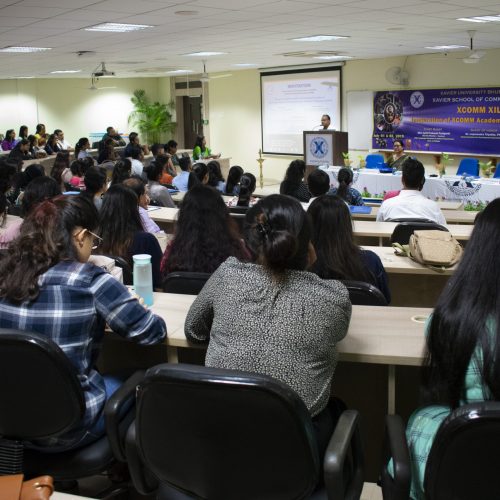
As per the National Education Policy (NEP) of India 2020, learners will be able to choose their learning programs and there will be no hard separations between ‘arts’ and ‘sciences’, between ‘curricular’ and ‘extracurricular’ activities, between ‘vocational’ and ‘academic streams’, etc. The School of Communications in line with the NEP framework offers an undergraduate program of 4-year duration, with multiple entry and exit points and re-entry options with appropriate certifications such as follows:
- A certificate after completing 1 year (first two semesters) of study,
- A diploma after 2 years (first four semesters) of study,
- A bachelor’s degree after a 3-year (first six semesters) of study,
- A bachelor’s degree with honours after a 4-year (with eight semesters) of study with research or without research.
The courses offered in the program will focus on creativity and critical thinking, ethics and human & constitutional values, and life skills such as communication, cooperation, teamwork, and resilience and broaden the horizon of academic learning. The motto of XIM University is Semper Excelsius – Ever Higher and the School of Communications stands with this as it imparts value-based education to include the development of humanistic, ethical, constitutional, and universal human values of truth, righteous conduct, and citizenship values.
PROGRAM GOAL :
The courses are designed to emphasize the analytical and ethical requirements of responsible scholarship. All the courses prepare students for personal success and leadership through informed and ethical communication teaching and research in and for a world of diversity, equity, inclusion, and social justice. The school is committed to the cultivation of an inclusive learning environment where diverse perspectives are recognized, respected, and seen as sources of collegiality and strength. We expect that our students will respect differences and demonstrate diligence in understanding others’ perspectives, behaviours, and worldviews that may be different from their own. The objective of our pedagogy is to embrace the position that our intellectual community is enriched and enhanced by diversity along many dimensions. We value the intersections of these experiences and characteristics in this global village.
PROGRAM OBJECTIVES:
To motivate, nurture and prepare the media and communication leaders of the future, and to help create a network of capacity builders, the School of Communications offers a BSc (Hons) in Media Studies which aims to generate a crop of conscientious agents for positive social change. In addition, we prepare students to take their place as responsible leaders, engaged citizens, and pioneering problem-solvers in their communities and chosen fields of work. Students can learn to evaluate and produce communicative texts that adapt to changing situations and audiences. As a result, the undergraduate curriculum rigorously prepares students for future work and study in any number of diverse fields, such as journalism, audio-visual production, advertising, public relations, event management, graphics and animation, media research, consulting, and many others.
Frequently Asked Questions:
Q1. What makes XIM University’s program one of the options for the best media studies degree India offers?
A: Our program uniquely blends a major in Media Studies with a minor in Liberal Arts, offering 171 credits over 8 semesters, hands-on industry exposure, and alignment with the National Education Policy (NEP) 2020.
Q2. What is the duration of this media studies degree India program?
A: It is a 4-year full-time undergraduate program. However, in line with NEP 2020, it offers multiple entry and exit points (Certificate after 1 year, Diploma after 2 years, Bachelor’s degree after 3 years, and Honors after 4 years).
Q3. What subjects are covered in the best media studies degree India curriculum?
A: The curriculum covers core areas like Journalism & Mass Communication, Digital Film Making, Sound Engineering, Graphic Design, Advertising & Public Relations, and emerging technologies like AI tools for media.
Q4. Is a summer internship mandatory for this media studies degree India?
A: Yes, a mandatory Summer Internship Programme is built into the curriculum at the end of the second year (Semester IV) to provide real-world industry experience.
Q5. Can I choose a research track in this media studies degree India?
A: Yes. In the 4th year (Semesters VII and VIII), students can choose either a “With Research” track (featuring a 12-credit dissertation) or a “Without Research” track focusing on industry readiness and brand management.
Q6. What career opportunities open up after graduating from the best media studies degree India?
A: Graduates can pursue diverse careers in journalism, audio-visual production, advertising, public relations, event management, motion graphics, media research, and corporate communications.
Q7.Are there digital marketing and online learning components in the program?
A: Yes, the course integrates Digital & Social Media Marketing and offers optional NPTEL SWAYAM MOOC courses during the fifth and sixth semesters.
Q8. How does the curriculum incorporate modern technology like Artificial Intelligence?
A: The 7th semester includes a specialized module on “Artificial Intelligence Tools for Media & Communication” to ensure students are future-ready.
Q9. Does this program focus on media laws and ethics?
A: Absolutely. In the 6th semester, students undergo a dedicated course on Legal Environment, Media Law, Ethics & Human Rights to promote responsible and analytical scholarship.
Q10. What is the total credit requirement for this BSc Hons Media Studies degree?
A: The program requires a total completion of 171 credits spread across eight semesters.
B.Sc. (Hons.) MEDIA STUDIES - COURSES
(Major in Media Studies and Minor in Liberal Arts)
SEMESTER – I
| Sl. No. | Course Name | Type of Course | Credits |
|---|---|---|---|
|
1 |
Introduction to Journalism & Mass Communication |
Major |
4 |
|
2 |
Mass Communication Theories
|
Major
|
4 |
|
3 |
Social Psychology, Audience, Art & Aesthetics |
Minor
|
4 |
|
4 |
Fundamentals of International Relations |
Multidisciplinary
|
4 |
|
5 |
English Communication – I |
AEC |
2 |
|
6 |
Digital Still Photography
|
SEC |
2 |
|
7 |
Community Engagement |
VAC |
2 |
|
|
22 |
||
SEMESTER – II
| Sl. No. | Course Name | Course Category | Credits |
|---|---|---|---|
|
8 |
Introduction to Film & Audio-Visual Production |
Major |
4 |
|
9 |
Digital Radio Production, Audio Engineering & Video Editing |
Major |
4 |
|
10 |
Media, Religion, Culture & Society |
Minor |
4 |
|
11 |
Principles of Management |
Multidisciplinary |
4 |
|
12 |
English Communication – II
|
AEC |
2 |
|
13 |
Computer Application for Graphic Design |
SEC |
2 |
|
14 |
Universal Human Values
|
VAC |
2 |
|
|
22 |
||
SEMESTER – III
| Sl. No. | Course Name | Course Category | Credits |
|---|---|---|---|
|
15 |
Advertising & Public Relations |
Major
|
4 |
|
16 |
Entertainment Media & Production
|
Major
|
4 |
|
17 |
Environmental Science & Sustainable Communication
|
Minor |
4 |
|
18 |
Computer Applications for Data Analytics
|
Multidisciplinary |
4 |
|
19 |
Creative Writing
|
AEC |
2 |
|
20 |
Graphic Design for Print & Digital Media
|
SEC |
2 |
|
21 |
Health & Wellness |
VAC |
2 |
|
|
22 |
||
SEMESTER – IV
| Sl. No. | Course Name | Course Category | Credits |
|---|---|---|---|
|
22 |
Digital Film Making |
Major |
4 |
|
23 |
Health & Development Communication |
Major |
4 |
|
24 |
Media, Marginality & Empowerment |
Minor |
4 |
|
25 |
Organizational Behavior |
Minor |
4 |
|
26 |
Writing for Media
|
AEC |
2 |
|
27 |
Motion Graphic Design
|
SEC |
2 |
|
28 |
Digital & Technological Solutions |
VAC |
2 |
|
|
23 |
||
|
29 |
Summer Internship Programme |
|
2 |
SEMESTER - V
| Sl. No. | Course Name | Course Category | Credits |
|---|---|---|---|
|
30 |
Digital & Social Media Marketing/ NPTEL SWAYAM MOOC
|
Major |
4 |
|
31 |
Corporate Communication |
Major |
4 |
|
32 |
Web Designing |
Major |
4 |
|
33 |
Event Management |
Major |
4 |
|
34 |
Convergent Journalism, Anchoring & Presentation |
Major |
4 |
|
35 |
Instructional Design & Production |
Minor |
4 |
|
|
24 |
||
SEMESTER – VI
| Sl. No. | Course Name | Course Category | Credits |
|---|---|---|---|
|
36 |
Design Thinking for Communication/ NPTEL SWAYAM MOOC |
Major |
4 |
|
37 |
Legal Environment, Media Law, Ethics & Human Rights |
Major |
4 |
|
38 |
Animation & Visual Effects |
Major |
4 |
|
39 |
Advance Journalism Studies |
Major |
4 |
|
40 |
Documentary Film Production |
Major |
4 |
|
41 |
Personality Development & Digital Workplace |
Minor |
4 |
|
|
24 |
||
SEMESTER – VII (With Research)
| Sl. No. | Course Name | Course Category | Credits |
|---|---|---|---|
|
42 |
Media & Communication Research |
Major |
4 |
|
43 |
Advance Research Tools |
Major |
4 |
|
44 |
Visual Culture & Communication |
Major |
4 |
|
45 |
Artificial Intelligence Tools for Media & Communication |
Major |
4 |
|
46 |
Well-Being & New Age Leadership |
Minor |
4 |
|
|
20 |
||
SEMESTER – VII (Without Research)
| Sl. No. | Course Name | Course Category | Credits |
|---|---|---|---|
|
47 |
Media Entrepreneurship |
Major |
4 |
|
48 |
Media Economics & Governance |
Major |
4 |
|
49 |
Global & Cross-Cultural Communication |
Major |
4 |
|
50 |
Artificial Intelligence Tools for Media & Communication |
Major |
4 |
|
51 |
Well-Being & New Age Leadership |
Minor |
4 |
|
|
20 |
||
SEMESTER – VIII (With Research)
| Sl. No. | Course Name | Course Category | Credits |
|---|---|---|---|
|
52 |
Dissertation |
Major |
12 |
|
|
12 |
||
SEMESTER – VIII (Without Research)
| Sl. No. | Course Name | Course Category | Credits |
|---|---|---|---|
|
53 |
Crisis Communication |
Major |
4 |
|
54 |
Brand Management |
Major |
4 |
|
55 |
Industry Interface Experience |
Major |
4 |
|
|
12 |
||
|
Total Credits |
171 |
||
AEC = Ability Enhancement Course, SEC = Skill Enhancement Course, VAC = Value Addition Course